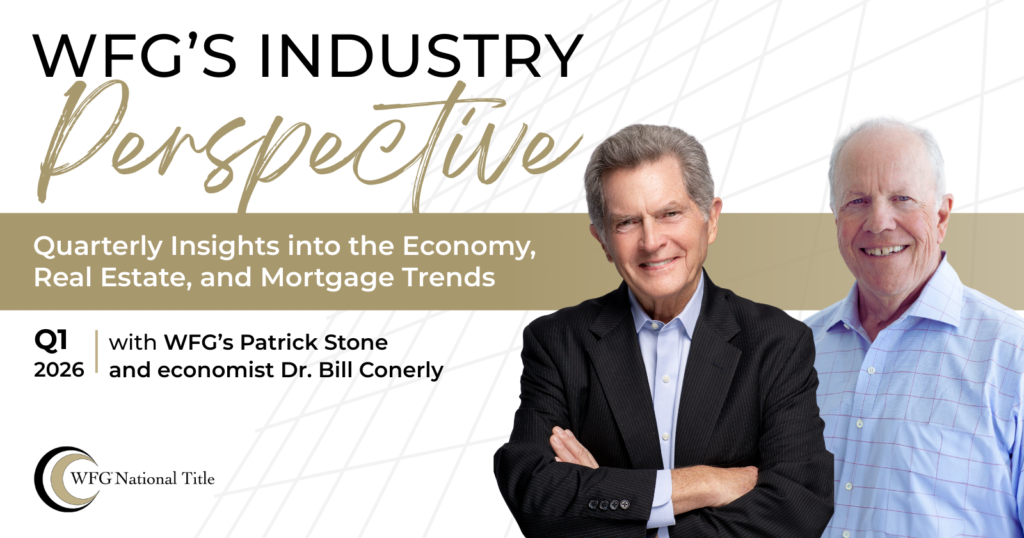
In the Q1 2026 installment of WFG’s Industry Perspective, WFG Founder and Chairman Patrick Stone and economist Dr. Bill Conerly joined host Ken Perry of The Knowledge Coop to examine the economic forces shaping the real estate, mortgage, and title industries in the year ahead.
The quarterly podcast, a reboot of WFG’s longtime Quarterly Economic Outlook webinar, provides timely insights into market conditions, housing demand, interest rate trends, and emerging risks affecting the real estate transaction ecosystem.
In this episode, Stone and Conerly discussed the outlook for the U.S. economy in 2026, the balance between housing supply and demand, and how technologies such as artificial intelligence are improving efficiency across real estate transactions.
Conerly noted that the U.S. economy is expected to continue growing, though at a more moderate pace than in recent years. Demographic trends and reduced immigration are contributing to slower labor force growth, but productivity gains should continue supporting economic expansion.
Stone added that the housing market today appears more balanced than it has been in several years, with supply and demand moving closer into alignment across many regions. “Overall the market is as balanced as it’s been for quite a while,” Stone said during the discussion, noting that conditions still vary by region. While affordability challenges remain, rising incomes relative to inflation may gradually help restore consumer confidence over time.
The conversation also explored how artificial intelligence is beginning to streamline real estate transaction processes. WFG is actively implementing AI-driven tools designed to reduce processing time and improve operational efficiency across the closing lifecycle. For example, automation of buyer and seller documentation packages has already reduced processing time by 30 to 40 minutes per transaction.
Throughout the discussion, both experts emphasized the importance of focusing on fundamentals: serving customers well, managing costs, and maintaining disciplined operations regardless of economic cycles.
Looking ahead to the rest of 2026, the panel encouraged industry professionals to closely watch key indicators such as employment, inflation and interest rates while continuing to focus on customer service, operational efficiency, and long-term strategic planning.
Key Takeaways
• Economic growth is expected to continue at a moderate pace as demographic shifts slow labor force expansion while productivity supports ongoing growth.
• Housing supply and demand are becoming more balanced across many markets after several years of volatility.
• Mortgage rates are influenced by global capital markets, not just Federal Reserve policy.
• AI is beginning to streamline real estate transactions, helping reduce processing time and improve operational efficiency.
• Strong fundamentals remain critical, including operational discipline, customer service and adaptability in changing market conditions.
Watch or listen to the Q1 2026 episode of WFG’s Industry Perspective here: